Factory License
Benefits of having Factory License
- Legal approval to run a factory in Delhi
- Compliance with labor and safety laws
- Protection from penalty & legal action
Table of Contents
About FactoryLicense.in
Contact Us
What is Factory License?
A Factory License is a compulsory permit granted by the Department of Factories in accordance with the Act of Factories, 1948. Every establishment engaged in manufacturing, processing or assembling process in Delhi is to applied for this license before using it. This is a process to guarantee that garments are manufactured in factories with appropriate safety procedures, and decent working conditions of labor welfare laws.
A Factory License serves as the legal permit for operating manufacturing processes and is also recognized as the compliance certificate by which employers are protected against penalties. Detailed documents pertaining to factors of the factory site, machinery, workers safety and environmental norms have to be submitted. If you want to apply factory license for your manufacturing unit you need to follow certain guidelines and rules precribed by labour department of the respective states.
Why you should apply for Factory License
As a requirement factory licence is indispensable as a regulatory device for manufacturing units. It’s main use is to ensure that industrial facilities are kept within limits set by authorities of governments.
This license is designed to uphold safety and health norms in manufacturing environment. It makes sure factories follow environmental laws, protecting both workers and the neighborhood. A factory licence also ensures fair competition among enterprises. Companies that follow established standards can avoid unethical behaviour which may potentially damage their reputation.
Besides, It definitely builds customer trust to have this license. Consumers would have confidence in a licensed producer that has quality control. A factory license is a narrative way that connects regulatory authorities and entrepreneurs, to inculcate professionalism at the same time encourage operational smoothness in the manufacturing industry.
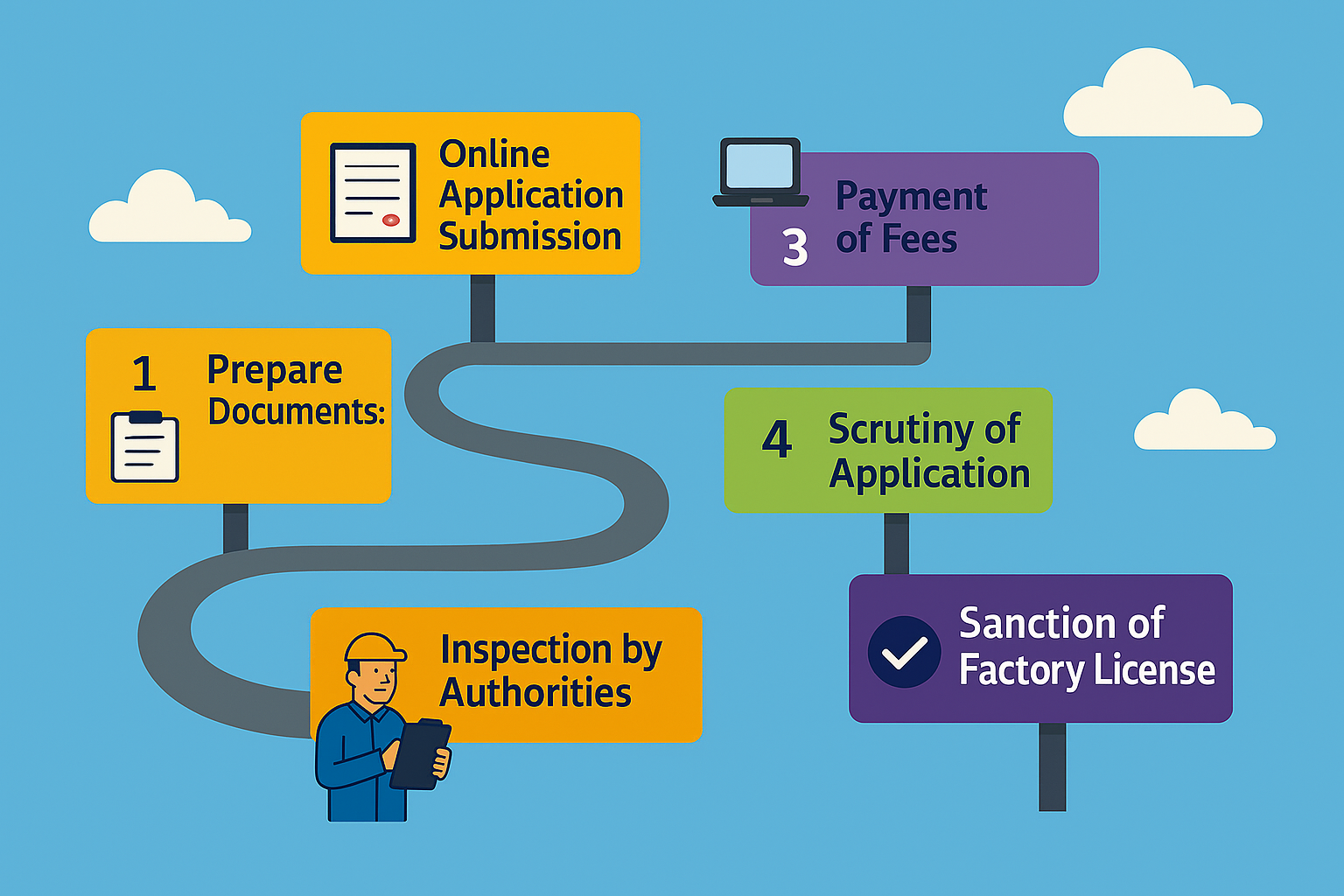
Application Process to get Factory License
Step 1: Prepare Documents:
- First of all you have to gather and organize all necessary documents mentioned as below:
- Factory layout as approved by the Directorate of Factories
- Proof of identity and place of residence of the occupant / manager
- Ownership / Lease deed of the factory premises
- Particulars of machineries and installed horse power (HP)
- Employment list for workers and job details to be proposed
- NOC of Pollution Control Board (if applicable)
- Fire Department NOC (applicable for some categories)
Step 2: Online Application Submission
- Check out the official Labour Department/Factory Licensing Authority portal. like for Delhi it is issued by Municipal Corporation of Delhi and application is to be made on MCD Portal.
- Fill up the application form mentioning Name of Occupier, Type of Manufacturing process, Number Of Total Workers and Installed machinery.
- Feel free to submit your documents along with the application in the below comment box.
Step 3: Payment of Fees
- Make payment of the stipulated government fees online based on workforce and installed horsepower (HP) of machinery. A Fee Receipt is automatically generated and same should be kept by applicants for their reference.
Step 4: Scrutiny of Application
- The relevant agency will then review the application and documentation. If additional information or document is required, the applicant will be informed.
Step 5: Inspection by Authorities
- The factory Inspector visits once for ensuring that safety, health and welfare provisions are being complied with. He looks for proper ventilation, fire safety, facilities and safeguards on machinery.
Step 6: Sanction of Factory License
- On acceptance of the application and inspection, the Factory License is granted. The license is good for a limited time, usually one year, and must be renewed prior to its expiration.
Requirements and Documents for Factory License
Requirements:
- The premises should have the status of a ‘factory’ under Factories Act, 1948.
- The appointment of an occupier and a manager to the factory is necessary.
- There must be sufficient safety, health and welfare arrangements in operation prior to work starting.
- Such factory site plan shall be approved by the Directorate of Factories.
- Relevant NOCs (Pollution, Fire etc) would be applicable as per the nature of Manufacturing activity(you require to obtain few NOC like Pollution,Fire Etc).
Documents Needed:
- Occupier’s proof of identity (Aadhar Card, PAN Card, Passport etc.) 5.
- Occupier and Factory premises address proof (electricity bill, rent agreement, ownership deed)
- Recent photographs of the occupier/manager
- Partnership deed / MOA & AOA / LLP agreement / Board Resolution (for company/partnership/LLP)
- Plant layout as approved by the competent authority
- List of directors/partners with the ID and address proofs
- Particulars of the machinery fitted and total HP.
- Consent/NOC of Pollution Control Board (if applicable)
- Fire Safety NOC (where applicable)
- Proof of property tax payment/Lease Agreement/Sale Deed of the premises
- Resolution deciding occupier and manager of the factory
Who needs to apply factory License?
Under the Factories Act, 1948 (and corresponding state rules):
- Any manufacturing unit employing 10 or more workers with power; or
- Any unit employing 20 or more workers without power;
must apply for registration and obtain a factory License factory License. Individual state rules may vary slightly, so always check local notifications.
Fee structure & validity for Factory license
Fees depend on state rules and typically vary by: installed horsepower, production scale and number of workers. For example, some states set fees in slabs (small, medium, large plants). A typical pattern:
- License validity often runs till 12 months of the grant year in some jurisdictions, with renewal options for 1 or 5 years.
Renewal, amendment & record-keeping for factory License
Renewal: Submit renewal application with original license and required fees before expiry. Timelines vary; apply early to avoid late penalties.
Amendments: Any change in occupier, ownership, production process, installed horsepower, or factory layout usually requires amendment to the license and sometimes fresh plan approval.
Records: Maintain registers and records specified under the Factories Act (attendance, accident register, annual returns, health & safety records). These are inspected regularly.
Table of Contents
FAQ
What is a Factory License and why is it needed?
A factory License authorizes a premises to carry out manufacturing and ensures compliance with the Factories Act, protecting workers’ health, safety and welfare.
Who must apply Factory License?
Any unit with 10+ workers (with power) or 20+ workers (without power) typically needs to register and obtain a factory License factory License. Check your state rules for exact thresholds.
When should I apply for a Factory License?
Apply after you receive plan approval and before commencing manufacturing operations. For construction/extension, get plan approval first.
What documents do I need for Factory License?
Key documents include approved plans, ownership/lease proof, electricity/load proof, pollution consent (if applicable), occupier nomination and safety policy for hazardous processes.
How long is a Factory License valid and how is renewal handled?
Validity varies by state. Many states permit 1- or 5-year renewals; apply before expiry and pay the prescribed renewal fee.
What happens if I operate without a Factory License?
Operating without a valid factory License factory License can lead to fines, legal action, and potential closure until compliance is met.
Can the Factory License be amended?
Yes — changes in ownership, capacity, process or location generally require amendment and, in some cases, fresh plan approval.